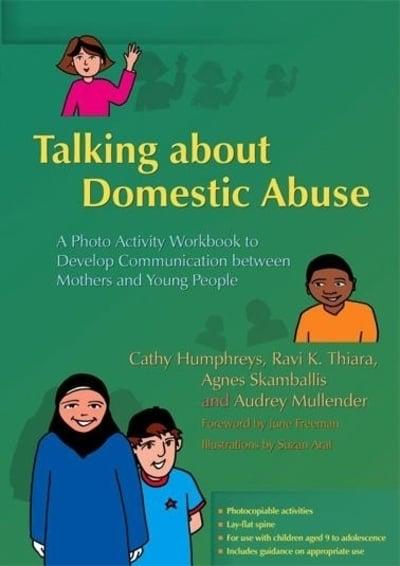
Talking About Domestic Abuse is an activity pack for children of 9 years and above and adolescents where families have experienced domestic abuse, to help and encourage them to open up to their mothers about their distressing experiences.
Based on the authors’ work with families who have experienced domestic abuse, the activities are designed around four important themes: building self-esteem; naming feelings; facilitating communication between mothers and children; and talking about personal experiences, including domestic violence, and are accompanied by photographs which act as prompts for discussion.
The authors explain the need of young people to communicate with their parents about painful memories. They also establish practical ‘ground rules’ on how mothers can enter into that communication successfully and how to make the most of the activities provided. Further information is also given on support services that are available to families coping with domestic abuse.
This will be an essential tool for families including young people who have lived through domestic abuse, as well as social workers and other professionals working with them
Contents:
- Acknowledgements
- Foreword by June Freeman
- Introduction and guidance
- Section 1: Early days
- 1. Things about me and Mum
- 2. Feelings tree
- 3. What makes us feel good
- 4. What I think about the place where I live now
- 5. Shared living areas – what’s the big idea?
- 6. Having a bad day
- 7. Feelings puzzle
- 8. Checking in.
- Section 2: Talking about things that matter
- 9. Sharing the good times: A starring memory
- 10. The secrecy habit
- 11. Don’t bottle it up! Talking about feelings
- 12. Excitement and fear
- 13. Let’s talk about anger
- 14. Things I like and things Mum likes
- 15. Changes in my family
- 16. Feelings about Dad
- 17. Chilling out
- 18. Other issues outside the home
- Section 3: Moving on
- 19. Keeping track of my life
- 20. Worries and excitement
- 21. Risks and safety
- 22. Changes we have made
- 23. Moving on – where next?
- 24. Looking backwards, looking forwards
- Certificate
- Reflection sheet and feedback form
- Conclusion
- Useful contacts.
Author Bio:
Cathy Humphreys is a senior lecturer in Health and Social Work at the University of Warwick. She has worked as a practitioner, researcher and educator in domestic violence and child abuse. Catherine’s other research areas include substance misuse, mental health, outreach and advocacy services for both women and children, and child contact.
Ravi K. Thiara is Principal Research Fellow, University of Warwick, UK. She has conducted extensive research in the UK and elsewhere and written widely on violence against women.
Audrey Mullender is Principal of Ruskin College, Oxford, UK. Her distinguished research career has focused on domestic violence, post-adoption issues for birth relatives and groupwork theory.